Arduino Soil pH Meter with PH-4502C Sensor and Two-Point Calibration
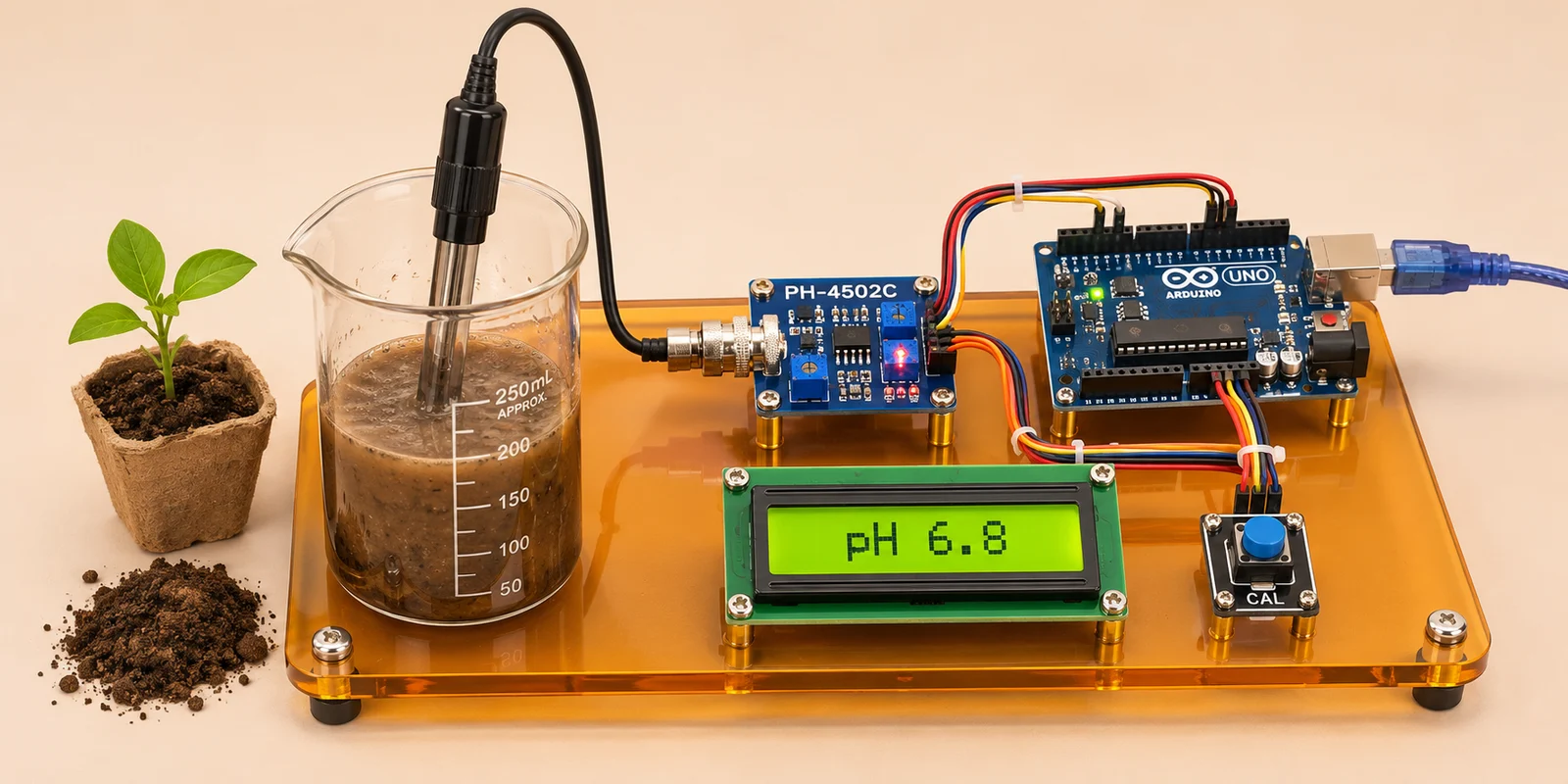
Build a soil pH meter: calibrate a PH-4502C probe with two buffer solutions, average its noisy readings, show the pH with one decimal and tell the farmer whether the soil needs lime or gypsum.
Your project challenge
Show Put in pH 6.86. On a CAL press, average 20 readings of A0. Do the same for Put in pH 4.00. A line through the two points turns volts into pH: show it with one decimal, like pH 5.6. Row 2: under 6.0 SOUR: add lime, over 7.5 SWEET: gypsum, else GOOD.
Components you’ll use
- Arduino Uno
- pH Sensor (PH-4502C)
- Pushbutton
- LCD 16x2 Display
What you’ll build
A pH meter for soil and water, like the ones farmers and hydroponic growers carry. Farmers call acid soil sour and alkaline soil sweet. Your meter tells them which, and what to add.
How it works
The glass probe makes a tiny voltage that changes with pH. The blue board makes it bigger on Po: higher pH, lower voltage. Use the probe’s buttons to dip it in a buffer sachet, or its slider for a soil sample.
The key idea
No two probes are the same, so the meter learns its probe. Buffers have a known pH. Read the 6.86 buffer, then the 4.00 buffer: two points make a straight line, and the line turns any voltage into pH.
⚠ Watch out
One reading jumps around, so average 20. A formula from the internet fits someone else’s probe. Use float, not int, or the decimal is lost.
Make it yours: add a third check with the 9.18 buffer and show how far off the line it is.
The editor has the wiring guide, the code and the simulator.
Build this project